Episode 4004

Don't have the PBS App? Click Here
Episode Transcript
- [Presenter] "Tennessee Crossroads" is brought to you in part by-

- [Narrator] Some of our biggest checks have also made the biggest difference. The Tennessee Lottery, proud to have raised more than $7.5 billion for education. Now that's some game-changing, life-changing fun.

- [Narrator] Discover Tennessee Trails and Byways, where adventure, cuisine, and history come together. With 16 scenic driving trails, you can discover why Tennessee sounds perfect. Trips can be planned at tnvacation.com.

- [Narrator] Middle Tennessee State University College of Liberal Arts helps students explore the world, engage minds, enrich lives, and earn a living. More at mtsu.edu/cla.

- This week on "Tennessee Crossroads," we visit an out of the way food stop where the tater gets a lot of attention. We'll head to the Cumberland Plateau in a history-filled state park. We'll meet a Nashville artist focused on those who might have been previously overlooked, and we'll get a peek back in time at the early days of a famous barbecue contest. See, we've always known good barbecue. Howdy, everyone. Thanks for joining us, I'm Ketch Secor, welcoming you to "Tennessee Crossroads." You know, we like to take you off the beaten path here on "Tennessee Crossroads," and in our first segment, Cindy Carter stays true to that mission. She found a little restaurant about 40 minutes south of Nashville where the tater is one of the stars of the show.

- [Cindy] It's true, this cafe is small, just six tables in all. And yes, it's located in the small, unincorporated community of Rockvale, Tennessee.

- I mean, we're in the middle of nowhere. We call ourselves a hole in the field because we're just out there.

- [Cindy] But make no mistake, The Fried Tater Cafe is anything but small potatoes.

- [Todd] Bye guys. Good to meet y'all.

- [Cindy] Owners, Todd and Jana Lake say they never dreamed so much community and purpose could grow from a simple spud.

- I was a little bit too like, what are fried taters? What exactly is that, are they, do they go in the pan? Do they go in the oven, do they, and so I had to learn that. I had to learn some of that Southern culture.

- [Cindy] The Lakes, self-proclaimed Yankees, took over The Fried Tater Cafe after its previous owner decided to sell. Sure, they considered a new name, but just couldn't, wouldn't fight what was already working like a Southern charm.

- [Todd] It's interesting because everybody at the beginning would come in and, "Hey, I want fried taters, I want fried taters, I want fried taters!" And it's like "Well, we don't offer them during the day. We offer them in the meet and three." And now it's just, the name has stuck. And there's no going back on where it's at right now with being The Fried Tater Cafe.

- [Cindy] But if you do go back into the cafe's history, you'll find that this spot has always played a vital role in the community that surrounds it.

- [Todd] The building itself is over 300 years old. It's been in the Nance family since it was built and they still own the building. It's been an Indian trading post. They used to come here to register for the army. It used to be two different grocery stores, Versailles Grocery Store.

- [Cindy] Yes, that's how they pronounce it around here.

- [Todd] Everybody still remembers it. A bunch of the old timers come in and talk about it.

- [Cindy] Tennessee license plates cover holes in the old floors, and the cafe is appropriately decorated with items that reflect its rich history, many donated by the locals who gather here. Conversation starters if you need them, that is if the food doesn't grab your full attention.

- [Todd] When we took over, there was only six menu items. And now we have appetizers, we have burgers, we have Reubens, we have Philly cheese steaks.

- The Fried Tater specializes in Southern comfort food. Hand-padded specialty burgers, daily specials, meat and threes, and a variety of fried pies for dessert. Because the restaurant is located in a historic building that cannot be altered, all of the food preparation is done in this kitchen trailer. Now, the Lakes have changed the menu over the years, but they still cook up those taters in the form of tater tots, pan-fried taters, and of course, the tater tornado.

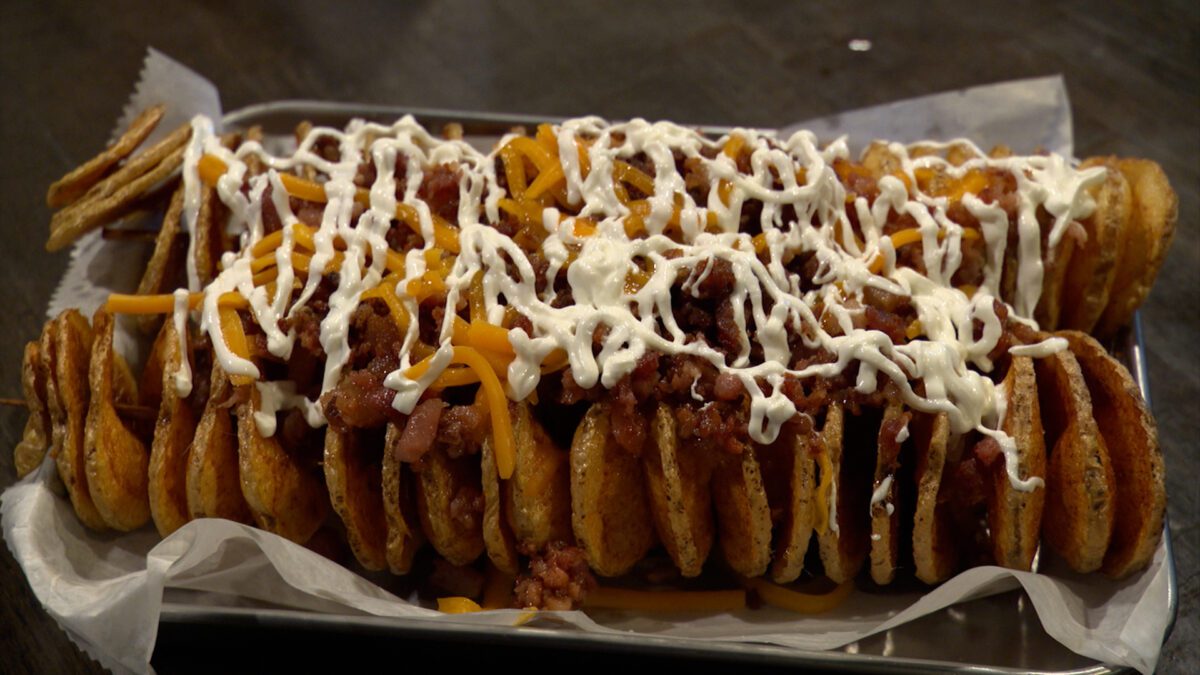
- [Todd] Probably our biggest appetizer is the tater tornado that we have that it's kind of like at the fair where we spiral a potato. We deep fry it, fried tater. So we deep fry it and then you can put some toppings on there.

- [Cindy] Toppings like pulled pork, bacon, cheese, sour cream.

- [Jana] Some people get all of it, which is a lot, but hey, we don't judge.

- [Cindy] No culinary request is too big for Team Tater. And as far as the Lakes are concerned, everyone who walks through their door is also part of that team.

- The community's, you know, slowly accepting us as northerners, as Yankees. And just getting to know them and really feeling like we are a part of the community, that they are a family when we see them. And we've embraced them and they've embraced us.

- [Cindy] Great food is one reason why The Fried Tater Cafe is a success. The chance to visit, see neighbors, and experience something uniquely Southern are a few more.

- [Todd] It's a place to come, place to, again, stay in the country and settle down and not have all that hustle and crazy.

- [Cindy] The Fried Tater Cafe is more than a golden tribute to a favorite carb, it's a new chapter in a beloved place that has served this community for decades.

- Thanks, Cindy. That tater tornado looks like a meal in itself. Well, up next, we'll visit another Tennessee State Park with photographer, John Guider. This week, he'll take us to the Cumberland Plateau and a park that's as much about history as it is about its natural beauty.

- It's very rich in history here at Pickett State Park. The land was actually donated by the Stearns & Coal and Lumber Company in the early 1930s. And then in 1934, the CCC, or the Civilian Conservation Corps actually constructed the park. My name's Cameron Martin I'm the park manager at Pickett CCC Memorial State Park. And just a little bit about the CCC, it was a program under President Franklin Roosevelt's new deal to help stimulate the economy. It usually hired men between 18 and 25 years old to do public service work. They taught them valuable skills like masonry and carpentry, and they built hundreds, if not thousands of parks and built hundreds and hundreds and thousands of miles of trails throughout the United States. We're very, very rich in CCC history and very proud of it. One thing that people come here for are two things, peace and tranquility. This is a very, very remote park. You have to have a purpose to come to this park. It's about two hours from Nashville and Knoxville. So usually people that come here is not just passing through. They're actually coming here for a purpose. They're here to experience something here at Pickett State Park whether it be the abundance of natural resources or whether it be the rich CCC history, maybe going into our CCC Museum to learn a little bit about the CCC's history at Tennessee and at Pickett. We have a, probably hundreds if not thousands of sandstone rock features here at the park. We have two sandstone natural arches. One of them is over the lake. The other one is on the Natural Bridge Trail. And one of the most popular features in the whole area is Hazard Cave. One thing here at the park that's really popular is our 12 acre lake it's called a Arch Lake. The CCC actually formed this lake in the 1930s. They impounded Thompson Creek and formed a 12 acre lake. We have boating opportunities and swimming opportunities on the lake. You can bring your own watercraft either kayak or canoe or jon boat or you can rent some from the office from us and experience the lake. One of the major things that you can see here as far as wildlife is black bears. And I think 1995 or '96 they reintroduced black bears to this area. They were historically here in the late 1800s, early 1900s. And due to habitat changes, they were pretty much wiped off this area. So we can, you can see black bears here usually from about April all the way through early fall. Typically, they start coming active in May, usually around Memorial Day. And a lot of people ask if they need to be worried about black bears. They are a wild animal, but typically black bears here, usually if you just keep your distance, you can safely view them and experience something you can see at the Great Smoky Mountains here at Pickett State Park. Another thing that's really, really super popular here at Pickett is the glow worms. You get to see them usually it depends on weather and temperature. Usually around mid-April and they start to fade around mid-June to late June. They're essentially the larvae of a fungus nat. And in the larvae stage is when they're glowing, and this is one of the very few places in the Southeast that we have a good developed trail where you can see the glow worms and experience them here at Pickett State Park at Hazard Cave. We have a unique plant life, Roundleaf Catchflies, something that blooms in the summertime. Another unique tree that people always ask about when they come in the visitor center or stop a ranger is the Big Leaf Magnolia Tree. It's scattered throughout the park. It's a very unique tree. When I first started here in 2008, I always called it a jungle tree or an elephanteer tree because of the way the leaves look. They're very jungle-like. Unlike the Southern Magnolias, which people are used to, they actually lose their leaves in the wintertime, but they have the classic Magnolia flower. They're beautiful trees, and they're scattered amongst this whole area. We have 15 cabins. Five of those are the historic CCC cabins. We have five of the standard cabins and we have 5 deluxe cabins, so 15 in total. We also have a campground. We have over 20 sites that you can camp at in our campground, plus the 15 cabins. And they come fully stocked with linens and pots and pans and everything. I would say our peak time of year for visitation especially in our cabins would be October due to the leaf changes. You get a wide variety of colors here at Pickett, and it's one of the highlights of Pickett in October is the leafs. I grew up in Fentress County which is right down the road here in Grimsley. I actually have a special connection to Pickett. I had two great uncles in the CCC that actually worked here at Pickett and helped build the park. And their family, some of their children are still alive today and they they think it's really neat that now that I'm the park manager here taking care of the park that they built. And also my parents used to come here in the early 1970s I have a picture of them on the suspension bridge over the lake which is another really popular feature in the 1970s. And they think it's my family think it's really cool that I manage the park that they used to visit back in the 1970s before I was born. Sometimes I'm a talker, as my friends know, and I like to get to know individuals to know why they're coming to Pickett, a little bit about their life history. And one thing about being a Tennessee State Park Ranger is every day something's different. You don't just go in your office and get on the computer every day and do the same thing. One day you may be leading an interpretive program for children. You may be doing trail work, you may be doing a search and rescue, or maybe law enforcement. So the best thing about this job is uniqueness and not knowing what each day brings. It keeps things fresh, and that's what I love about this job.

- Thanks, John. Well, in our next story, Laura Faber meets a local artist who paints about honesty. Omari Booker likes to focus on the underrepresented in our society as portrayed in a mural he painted for a historically significant Madison neighborhood. ♪ La la la la la la la ♪

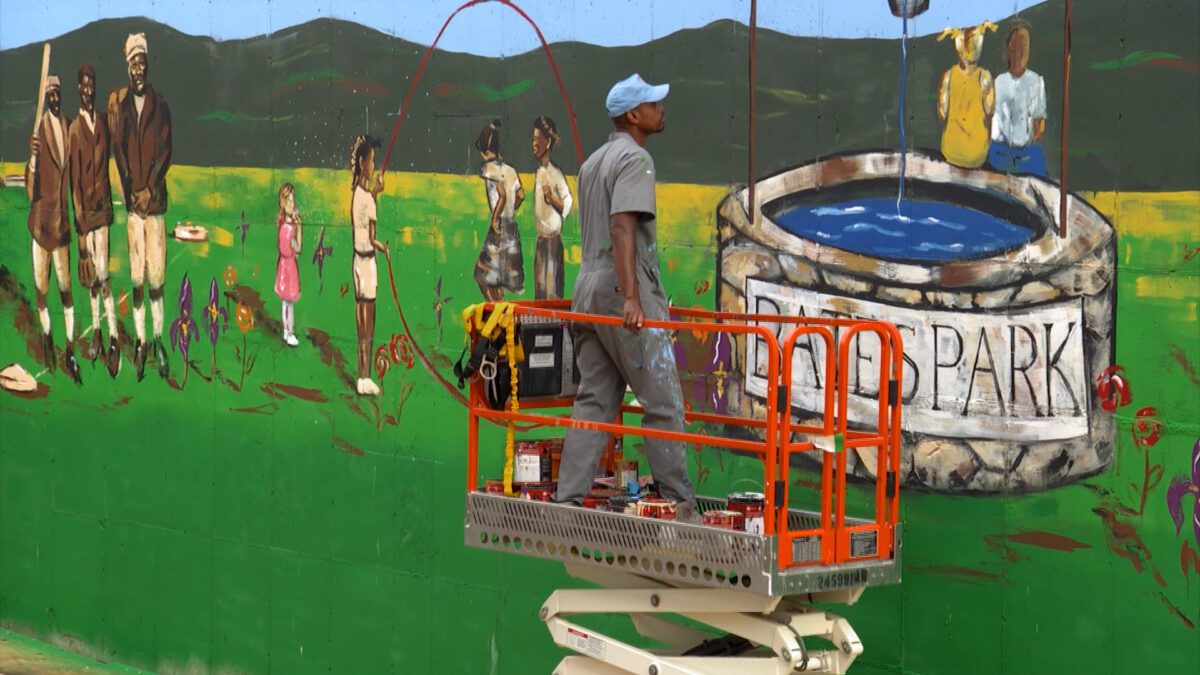
- [Laura] If you are lucky enough to see Omari Booker painting, you will probably see him working with oil-based paint. He uses acrylic and charcoal and other things too, but oil is his medium of choice. This is his latest work, a mural 55 feet long and 15 feet tall on a wall in a new apartment complex in Madison. Though the style may vary, what is constant about Omari's work is the story. There is always a story.

- I want to portray things, portray things as they are. And also looking at things that are traditionally maybe underrepresented. So working around things like incarceration, that was easy to get close to because that was part of my story, but I've also done a lot of work around people experiencing homelessness.

- [Laura] Omari's own story is something. Born in Virginia, his family lived in St. Croix for a bit, but Omari was raised in Nashville. His first art class was in high school, and he continued his art education alongside his math classes while a basketball star at Belmont University. Then Omari was arrested for drug possession. He served three years of a 15-year sentence and eventually graduated from TSU with a degree in graphic design.

- That's often how I, how I describe my first commissions. My first commissions were for soap and honey buns and toothpaste. It's a lot of bartering. So I did a lot of drawing for people. And then I started creating my own narrative and documenting what the prison looked like and the people. Yeah, just kind of how different it actually was from the perception of what people think that it is.

- Now, the wall Omari is painting on isn't just any wall, it's in the middle of a neighborhood on land that holds generations of history for one Nashville family. The family at the center of the mural is that of Randall Bates. His family lived on this land for generations.

- Bart Bates was the original owner, he was a slave. He was a slave actually in Gallatin, Tennessee, from what my grandfather told me. And when slavery was abolished, he was given this land by his slave owner to raise his family, farm the land. And that's what he did. It was a thriving neighborhood. I mean, above the street where as you come up to the left there, there was a baseball field. And that's where my grandfather played baseball, the Briarville baseball field. My dad played there.

- [Laura] And there is a story about a well on the land, a well featured in Omari's mural.

- The well was kind of where this building is. It was a well, that's where they got the drinking water. And the stories my grandfather told me is that all the neighbors in the general area would come miles and miles and miles to get the well water, because this was like the only source of water in this area.

- [Laura] Bates and his family recently sold the land to a developer with some strings attached, it must offer affordable housing.

- We sit down as a family and kind of looked at it and it was, it just made sense. All the development that's going on around Nashville, it, you know, it's not affordable anymore, you know, to the, what I call behind the scenes people. They got to live somewhere. Where these people gonna live? I mean, these people are in our lives every day. You know, they're at our restaurants. You know, they cut our grass, they clean our houses. They clean buildings, they're everywhere. You know, where they're gonna live.

- [Laura] Enter LDG Development and longtime Madison resident and former Metro Councilwoman, Nancy Van Reese.

- We are at the Briarville Apartments. And I say the Briarville because Briarville used to be actually an encampment of freed slaves and emancipated folks in Tennessee. And the little street named Briarville was the last thing that we had showing that history. And so we had the opportunity to make sure that this place was called The Briarville out of respect for the history of the Briarville encampment.

- [Laura] The community center here is named after Randall's great-grandfather. Locally created art hangs inside, featuring the musical history of Madison, nearby Amqui Station and Cedar Hill Park. And then there is the mural.

- We were looking for an idea how we were gonna pay tribute. We talked about, named some of the areas in the building after my family and talked about naming some streets and, but they wanted to do more, you know? It just wanted to do a little bit more. And so the idea of the mural came up and featuring my family.

- [Laura] A chance encounter between Nancy and Omari sealed the deal.

- I approached Omari with the idea of telling the history of the Bates family from 1863 to 2023. The mural is funded by the LDG Foundation, Amazon's Community Fund, the Memorial Foundation, and the Historic Foundation. The project is something that we're all extremely very, very, very proud of.

- It's emotional, you know? It's hard to believe. If we could do little small things like this and just kind of sprinkle these little ideas around, you know, not only here in Nashville, but everywhere.

- [Laura] The project and the story of Briarville couldn't be more inspirational for Omari Booker.

- Overwhelmingly grateful. Yeah, goosebumps. Yeah, to be a part of the people that make the place special. So I'm grateful to be a part of any project that is, that's making more space for the people that make the city what it is.

- Such meaningful and beautiful work from Omari Booker. Thank you, Laura. Well, this week on our "Retro Crossroads" segment, by the fourth season of "Tennessee Crossroads," we had already established one important thing, that Tennesseans love their barbecue. So back in 1990, Janet Tyson and the crew took a trip to Lynchburg where Tennessee's most popular distillery was gathering the best of the best of Tennessee smokers for their second annual barbecue contest.

- Now, there are two things that we at Tennessee Crossroads really love to do. One, of course, is to bring you good stories, and the other is to eat. So we followed our noses today to Lynchburg, Tennessee, to what just might be the largest backyard barbecue in the world. At the second annual Jack Daniels Barbecue Invitational, world champions are going rib to rib in some real hot competition.

- Doin' it.

- Oh wow. Ever since man invented fire, he's used it to cook up some real enjoyable concoctions. Judging from the hot competition at this second annual world-class cook-off, Jack Daniels may soon also be synonymous with barbecue. While champion teams from all over the country and around the world smoked, basted, and stirred up winning sauces, the people lined up to sample the sizzlings. It was a country fair type event with lots of fun for the whole family. It had everything from greasy fingers for mom and dad to a greased pole contest for the kids.

- Yeah!

- Yeah!

- Woo!

- Woo!

- [Laura] But there were some people here who took their efforts very seriously.

- I accept my duty, being Jack Daniels World Championship Invitational Barbecue Judge, so that truth, justice, excellence in barbecue, in the American way of life, may be strengthened and preserved forever.

- [Triangle Ringer] Come and get it, get it served.

- [Announcer] And they're off and they're racing!

- [Laura] While some ran for their lives, the barbecue cookers prepared succulent servings for the judges' consideration. Most of the participants had been cooking their entries all night. Mm, that is wonderful. What's your secret ingredient?

- Just a lot of hard work.

- A lot of hard work?

- [Laura] The judges had some hard work too, but all of them seemed to throw themselves into the job with gusto. Tandy Rice and Sharon Sanders, food writer for the Chicago Sun Times, pitted Rebel against Yankee taste buds.

- She fancies this one right here, and this one is so much superior, I can't imagine what's going on in her mind.

- Well, you've got the remnants of some judging here. What qualifies you to judge a barbecue content?

- It's very simple, I watch Bill Hall and I do everything he does. He's a world famous authority on chitlins and barbecue. When he nods his head, I say, "Great, great, yeah."

- [Laura] Charlie Virgos, owner of the world famous Rendezvous Restaurant in Memphis, knows his barbecue.

- They do a good job. The tenderness is there. They cook it well. I could see some that maybe use a little more hickory than I would normally use, I don't, you know, but it's just their way of cooking. It's just a, it's a matter of the taste and what part of the country you're from.

- [Laura] Bill Hall had so much fun as a judge last year he came back for seconds.

- Yes, because it's small town America, small town Tennessee, and I grew up in a small town like this, and things like this are just a part of me. I'd rather be doing this than, you know, at the opera in some big city or something like that.

- Ribs beats opera any day, huh?

- Oh, definitely. There's only one thing better and that's fishing. And so if I can't do one, I'll take the second best.

- One of the prizes today is awarded in the category of people's choice. That means that everybody who comes today gets to wander around and sample the barbecue and then vote for their favorite. So in the spirit of that event, it's time to pig out. Along with the Crossroads crew, there were some other pretty tough judges. My son, Matthew, usually a picky eater, turned into a piggy eater. This barbecue passed taste test by some of the most discriminating tasters in the world.

- You wanna dip?

- You want to dip it? Well, honey, it's kind of hard. Daddy will dip it for you.

- Okay. Want some?

- Aah.

- [Laura] It even got rave reviews from people with more uneducated palettes. You're from LA.

- Yeah, yeah.

- {Laura] So what do you know about barbecue?

- Well, there was no arugula lettuce or you know, shiitake mushrooms, but it was fine. It was great, it was great, yeah. If they served any of what I tasted today in a restaurant in Los Angeles there'd be lines around the block.

- [Laura] When the smoke cleared, there were well-fed folks everywhere dining pretty high on the hog. It was enough to make you lose your head over barbecue.

- And that barbecue contest, also known simply as The Jack, still takes place every year in October. Well, that's going to do it for us this week. Thank you so much for coming along. Be sure to check out our website at tennesseecrossroads.org for more of your favorite stories and to leave us a message for our 40th season. But most importantly, be sure to join us back here next time.

- I'm Les Kerr, a songwriter and musician from Nashville, Tennessee. Happy 40th anniversary, "Tennessee Crossroads."

- Hi, I'm John Summers from Nashville. Happy 40th anniversary to "Tennessee Crossroads."

- [Narrator] "Tennessee Crossroads" is brought to you in part by-

- [Narrator] Students across Tennessee have benefited from over seven and a half billion dollars we've raised for education, providing more than two million scholarships and grants. The Tennessee Lottery, game-changing, life-changing fun.

- [Narrator] Discover Tennessee Trails and Byways, where adventure, cuisine, and history come together. With 16 scenic driving trails, you can discover why Tennessee sounds perfect. Trips can be planned at tnvacation.com.
Tennessee Crossroads
August 27, 2026
Season 40 | Episode 04
THIS WEEK ON TENNESSEE CROSSROADS WE VISIT AN OUT OF THE WAY FOOD STOP WHERE THE ‘TATER’ GETS A LOT OF THE ATTENTION. WE’LL HEAD TO THE CUMBERLAND PLATEAU AND A HISTORY-FILLED STATE PARK. WE’LL MEET A NASHILLE ARTIST FOCUSED ON THOSE WHO MIGHT’VE BEEN PREVIOUSLY OVERLOOKED. AND WE’LL GET A PEEK BACK IN TIME AT THE EARLY DAYS OF A FAMOUS BARBECUE CONTEST.