Episode 4005

Don't have the PBS App? Click Here
Episode Transcript
- [Announcer] "Tennessee Crossroads" is brought to you in part by...

- [Lottery Spokesperson] Some of our biggest checks have also made the biggest difference. The Tennessee Lottery, proud to have raised more than $7.5 billion for education. Now that's some game-changing, life-changing fun.

- [Narrator 1] Discover Tennessee Trails & Byways, where adventure, cuisine, and history come together. With 16 scenic driving trails, you can discover why Tennessee sounds perfect. Trips can be planned at tnvacation.com.

- [Narrator 2] Middle Tennessee State University College of Liberal Arts helps students explore the world, engage minds, enrich lives, and earn a living. More at mtsu.edu/cla.

- This time on "Tennessee Crossroads," Laura Faber finds a meat and three in Portland making good Southern comfort food, Miranda Cohen helps release some prehistoric creatures back into the Tennessee waterways, Joe Elmore has his portrait made using a historic technique, and Al Voecks takes us back to 1991 to meet a young prodigy banjo player. And we'll tell you where he ended up. Hi, everyone. I'm Ketch Secor, welcoming you once again to "Tennessee Crossroads." Portland might be known as the Strawberry Capital of Tennessee, but this tight-knit community has something else worth checking out. It's a meat and three right on Main Street, where you can get good Southern comfort food, just like your meemaw used to make. Well, Laura Faber and the crew hit the road to see what people are putting on their plates in Portland.

- [Laura] It is a family affair on Main Street in Portland.

- Hi, y'all.

- [Laura] Christy Denning and members of her family have been cooking for others as long as she can remember.

- I started doing food for my cousins, and it was my dad's first cousin and his wife owned a restaurant. And me and their daughter used to run a restaurant at night in New Deal when we was 14 years old.

- [Laura] Her Top of the Ridge catering business came next, along with stepdaughter, Jessica Whitfield, who manages the catering.

- We never dreamed it would. We cooked two free meals, and after that, it took off. We had started hiring people to help us.

- [Laura] In 2022, they opened Top of the Ridge Restaurant in the heart of Portland.

- [Christy] I found this was empty. Me and Jessica came here to look, I don't know, two or three times.

- [Jessica] Yeah.

- [Christy] A lot of work.

- Yeah, it was a hot mess.

- It took us from October of '21? '22?

- 2021.

- '21 till February 1st was our opening day in '22. I thought, "What have I done?"

- It was crazy.

- It was.

- It was crazy.

- [Laura] What they do at Top of the Ridge is serve Southern comfort food, and customers of all ages can find something to love on the menu.

- [Christy] Get the grandma's home cooking.

- [Laura] A true meat and three, and then some. Think rotisserie chicken, meatloaf, baked ham, fried bologna with all kinds of sides.

- [Christy] We do pinto beans, turnip greens every day.

- And green beans and cream potatoes with gravy. We do scalloped potatoes. We do hash brown casserole, corn casseroles. Today, we're having jalapeno corn casserole, macaroni and cheese. Deviled eggs, we do deviled eggs every single day. We have a salad bar.

- [Laura] A real old-fashioned salad bar. Some customers come just for that. Plus, homemade fruit tea.

- And I make homemade chicken salad. A lot of people say it's better than another place that we know.

- [Laura] Friday nights are catfish nights.

- I like their catfish and their white beans. Their white beans are good.

- [Laura] Customers like 97-year-old Bill Engelmeyer have been a regular since day one.

- Well, they treat you like family here. In fact, the owner invites me to their family doing sometimes.

- For Philip Richardson, the best thing on the menu is either the rotisserie chicken or the fried bologna.

- Fried bologna's big in Portland. So I like home cooked food. That's what I was raised on. And it's home cooked food, and it's like coming home every time I walk through the doors.

- All right, I just have to show you this because it's a thing of beauty. One of their many homemade desserts at Top of the Ridge, everything's homemade here, but this is their banana pudding, their top-selling dessert, Christy's family recipe. And just look at that meringue. Christie's sister-in-law makes most of the desserts. Jessica makes them too.

- [Christy] Homemade layered carrot cake.

- [Jessica] Strawberry cake, that's a big one. The Holy Cow Cake is probably our number one.

- [Laura] What's that?

- [Jessica] It's the chocolate cake with caramel drizzled inside, Cool Whip on top, Heath Bar bits, and chocolate and caramel drizzle on top of that. They love it.

- Well, our number one seller is the banana pudding.

- Oh, yeah.

- The old fashioned with the meringue.

- Meringue.

- [Laura] So can you tell me about that, or is that a secret recipe?

- [Jessica] Yeah, it's secret, but.

- [Laura] Is it?

- [Christy] Yeah.

- Yeah, it's just if you you ever had a grandma that made meringue pies

- [Christy] When she brings them in, when they get done, like I've had people eating it for breakfast this morning because it was still warm when we set it out there.

- [Laura] I always wonder what it is about a small town restaurant that has survived and thrived like Top of the Ridge. Perhaps one reason is that it's very much a family business.

- And I have Kayla, that's my middle stepdaughter. I have my granddaughter, my grandson, my great niece.

- All of my kids work here, except for the one that's not old enough to work here. My best friend works here. My mother-in-law works here. My sister works here. My three oldest kids work here. My niece works here. We are a family here. Like 95% of the people that work here are family.

- [Laura] Or maybe it's simply good people who make good food from scratch.

- [Christy] Nobody cooks from scratch like we do, and it's expensive to do.

- [Jessica] It's very expensive.

- [Christy] And we can make a lot better living if we just bought stuff, but we don't do that.

- [Jessica] The service, the food. and everyone just loves our waitresses, loves Christy going around and talking to everyone. Every time someone's here, she acts like she's known them her whole life.

- [Christy] Sometimes it's not really like going to work some days.

- [Jessica] If you're good to people, they're going to be good to you and come back. And I like the food, and she likes the people, so it's just a great mix.

- That's a real family affair. No wonder it tastes like home cookin'. Thanks, Laura. Well, next, if you love getting out in the great fresh water of the Volunteer State, you may have some prehistoric species to thank for keeping our waterways clean. Miranda Cohen traveled to Chattanooga to meet a team of biologists at the Tennessee Aquarium who are helping some very special residents find their way back home.

- [Miranda] Every day is exciting at the Tennessee Aquarium in Chattanooga, but as you can tell, this day just feels a little more special.

- These are stream simulations.

- [Miranda] Director of Conservation, Stephanie Chance, is busy with her staff of biologists. They are like excited parents watching their children go off on their own. But in this case, they are a species of fish the state once considered endangered. These are lake sturgeon. And this dedicated team is thrilled to be introducing them back into Tennessee waters.

- We got those as young fry about an inch, inch and a half long last June. So we have been raising these lake sturgeon, a couple 1,000 or so, in our facility for the last essentially year. And today, we have 40 individuals that are over a foot long, and we're gonna be releasing those into the Tennessee River, right across the river from the Tennessee Aquarium.

- [Miranda] Once thriving in Tennessee, then due to environmental changes, their numbers started to rapidly decline. Then through a partnership with the Southeast Lake Sturgeon Working Group, the staff at the aquarium has released more than 430,000 sturgeon back into the Tennessee and Cumberland Rivers. Due to their ancient anatomy and primitive features, they are often called prehistoric, and it is thought they swam beside the dinosaurs.

- Lake sturgeon really are fascinating. Essentially, you can think of them as having a human lifespan. They might live 50 to 80 years.

- [Miranda] Today, the staff has moved all of the sturgeon into this holding tank, and they just seem to know something good is about to happen.

- We'll use this tub to transport the fish to another tub on the truck. Once we drive to the site, we'll use the same tub to get them off the truck and to the river. So we're filling it up with the water here that they're used to.

- [Miranda] They are then transported to the riverbank, where they are ever so gently moved.

- They're about to go to their forever home.

- You are the two sturgeon wranglers.

- [Miranda] And like with any big arrival, a little paparazzi is waiting.

- Have you ever had so many people filming you while you're pouring water out of a bucket?

- [Miranda] As Dr. Bernie Kuhajda and his team then take over the tender transfer, with precision and calculation, they will slowly add lake water to their container.

- [Dr. Bernie] It might be different pH, different alkalinity, and you just want to have them get slowly used to the different water chemistry and temperature.

- [Miranda] And then Dr. Bernie always has a few words of encouragement.

- So I have no doubt that you're gonna go into the Tennessee River. You're going to find plenty of food. You're gonna grow up to be big and strong. You're gonna find the love or loves of your life and make a bunch of babies, and you are going to live to 70, 80, maybe over 100 years old, so you guys go out there and enjoy life. It's gonna be fun.

- So it'll be a bittersweet release today as we send them off to their new home, and it's going to be so exciting.

- Today, these lake sturgeon are being released back into the Tennessee River. You can see they are absolutely beautiful. They are about a year old, and they have been tenderly cared for by the staff of the Tennessee Aquarium. Here he goes. He is going to find love and have a great and happy life. Good luck, buddy.

- And it does take 'em a little while, but some of 'em, they just get right on the bottom and swim off. Fish is just like people. They have different personalities. Some are a little bolder. Some are a little more timid. And so you kind of get a mixed reaction. By replacing a lost species from the Tennessee River and the Cumberland and Coosa River here in the Southeast, we are rebuilding that foundation for the aquatic ecosystem and making it healthier for the fishes, the aquatic critters, muscles, snails, crawdads, and humans. So it's all interconnected, and this is just one small part of that wonderful mosaic.

- [Miranda] Thanks to years of hard work, the lake sturgeon has now been officially moved off of the state's Endangered List and onto the Threatened List. The lake sturgeon are released two times a year, once in the spring and once in the fall. And you are welcome to watch and even lend a hand. To say the Tennessee Aquarium CEO, Andy Wood, is proud of his team and the life-changing work they are doing is an understatement.

- We are caring for these animals from when they're very small fry, and you spend every day making sure that they receive the absolute best care and are given the best chance to survive. It's beyond words. It truly is a team effort. It's the entire team. It's the entire organization. And we have pros who are dedicated every day doing this work and the rest that are standing ready to support however we can. So today is really one of those magical, special days, where you can return animals to their natural environment. These are dinosaurs. They're prehistoric creatures, and to be able to replenish their population is really special. And so this is a big special day for us.

- [Miranda] So when you're out enjoying Tennessee's beautiful waters, remember to say hello and welcome back to the again thriving population of lake sturgeon.

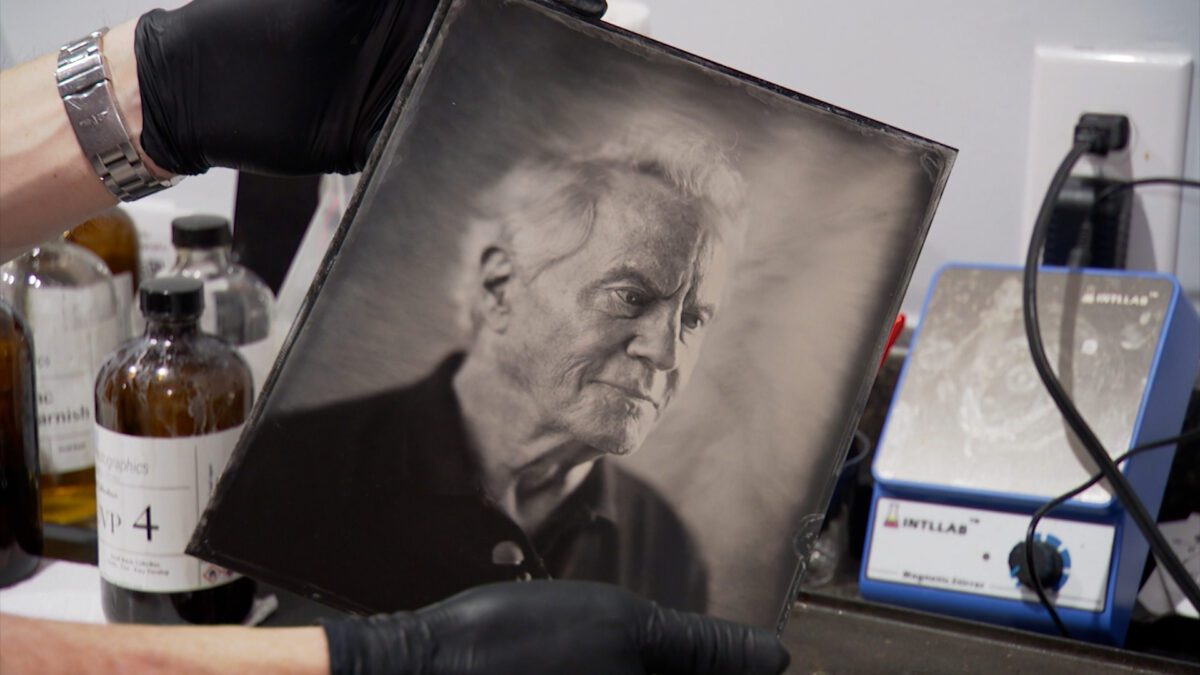
- Fascinating to see those creatures and what they do for our waterways. Thanks, Miranda. Well, lots of people have a side hustle these days, but very few have one like Blake Wiley. Blake's always loved photography, but several years ago, he discovered a basic historic process called tintype, and he loves to share this old time adventure with others.

- [Joe] While Blake Wiley's day job is in the tech industry-

- [Blake] All right.

- [Joe] He's always had a sideline love for photography.

- One, two, three.

- [Joe] First film, then digital, but later in 2005, Blake began to focus on a photographic process that's more than 170 years old.

- I had been researching and known about tintypes before I saw a guy doing the process. And I think the term was, "If you like history, if you like, you know, working with dangerous chemicals," and I was like, "Well, this is for me. Let's do it."

- [Joe] Cheaper than its predecessor, daguerreotype, tintype was a more affordable medium for 19th-century family portraits. You've probably seen them in antique stores. Well, these days, Blake welcomes curious clients to his home studio ready to have their image captured with this vintage process. For many, it's the nostalgia and being part of such a non-digital adventure.

- [Blake] There's a bit of a yearning, I think, in people for the old stuff, the old ways, right? Analog. You've got the record stores that are really popular today. It's very similar, right? You've got this very analog process, you know, and you actually get to hold something that is the actual, you know, picture that was taken. That's something that's gonna last for generations. and it can be passed through your family, or it may end up in an antique store itself one day. This camera, though, is a large format camera, 8x10. It's a Century Studio camera. Very beautiful wood camera I got from a guy up in New York. The lens I use also is essentially an antique lens as well. The depth of field is very narrow on the process. I mean, sometimes I'll take a photo and I can get somebody's nose out of focus and their eyes in focus when you're really close. So, you know, it's something where you're under the hood, you know, under the dark cloth, and everything's upside down and reversed. And so you're having to look at each focal point and get everything in focus as much as you can.

- [Joe] Before using the camera, though, Blake has to prep the metal plate, which will become the actual picture.

- Trophy aluminum is what it is. You have to have a black background for the portrait, for the picture to be taken on. And we pour the film on the actual plate. Come on in. Have a seat right here.

- [Client] All right.

- All right.

- [Joe] Well, today in the studio, Blake's subjects are Jason and Jenna Fessler. And the first order of business here is setting up this enormous light. That's because tintype likes lots of light.

- [Blake] All right, just some focusing.

- [Joe] Then the couple will need to stay still for the critical following step.

- [Blake] It's the focusing that's really the key piece, so if somebody moves, even just by a little bit forward or backwards, they're going out of focus. And I can't see that after I put the plate in the camera. So I can't see that they've moved. So there are some times where somebody's out of focus, and I may have to redo it. All right, one, two, three. Good job, guys. You can move and relax.

- Whoa!

- Yeah.

- All right, I'm gonna put that right there.

- Holy cow.

- [Joe] Finally, it's off to the dark room for developing, fixing, and varnishing the plate, and at last, the couple's finished tintype photo is good to go.

- For the people that come in, I really try to make it an immersive experience. So they get to see the process. I walk them through, tell them about the history. I get to show them. They get to smell everything as well, the chemicals, and I'll have people come in, and they're like, "This smells like my high school dark room," you know? When they were still doing dark rooms in high schools and colleges.

- [Joe] Now this story's not about me, but Blake insisted. Who knows? Maybe I'll end up in an antique store someday.

- A little dramatic lighting, if you don't mind.

- Oh, I love it, dramatic lighting.

- One, two, three. All right, now you can move.

- Wow. And what an incredible experience. But before leaving, I had a question for Blake. In those old tintype portraits, why did people never smile?

- [Blake] I think it was a very new thing, and they were used to seeing portraits, painted portraits, and people that were very still. And, you know, it was really a continuation of that in a way.

- [Joe] Anyway, Blake Wiley has a lot to smile about, enjoying his high-tech day job while pursuing this low-tech craft in the timeless world of tintype.

- It's kind of an honor for them to allow me to take their image like that because it's a slow process. The way the process is, you know, the engagement and the fact that they get to place this in their homes and enjoy it for generations even.

- Thank you, Joe, and Blake is still going strong with a new project called "One Take," where he features Nashville music makers. You can see that and more at his website. Well, speaking of music makers, if you're a fan of bluegrass music, and I am, you might just know the name Cody Kilby. He's made quite a career for himself as an artist with Ricky Skaggs and The Travelin' McCourys. And as Al Voecks showed us in this retro "Tennessee Crossroads" segment from our fifth season, even at 11 years old, playing banjo back in his parents' grocery store, he was something special.

- For the people who operate today's supermarkets, they will tell you that the competition is extremely keen. The object, of course, is to get people in this store and not in that store. That is why they will keep theirs as clean as possible. The produce will always be fresh, and the prices? Well, they will be the lowest possible. But Ronnie and Sharon Kilby, who run Kilby's BuyRite in Cowan, throw a little extra ingredient in every once in a while. They provide some good old toe tappin' entertainment. And the good part is it doesn't cost them anything. You see, their son Cody is a 10-year-old banjo player who will wander down to the store every so often for a little old picking and grinning. About three years ago, Cody picked up the banjo, and while most of us couldn't achieve this level by practicing 10 years or more, well, Ronnie and Sharon said it just kind of came natural to Cody.

- [Ronnie] My granddaddy played banjo, ukulele, piano. He was kind of musically inclined, but I think a lot of it's on his own. He's just a natural.

- He was eight, barely eight, and showed an interest right off from learning a song. "Oh! Susanna." I guess Ronnie picked it up by ear and showed him, and he played, you know, the song just by picking by ear and remembered it. And then after that, he started learning some songs that his dad had learned and remembered them, and fingers started moving faster.

- [Al] How does he handle it?

- [Ronnie] He's like he really hasn't accomplished anything. He's just a everyday kid. He doesn't really get excited over it. He just he doesn't really think he's doing anything special when he does it. He knows school comes first and banjo second. He doesn't see it that way sometimes.

- He had a lot of teasing probably in third grade when he was eight from playing this bluegrass and country music 'cause most of the kids like rock and roll. But that didn't seem to bother him. We told him to do what you like to do, you know, and if that's what you like to do, then don't worry about what someone else says.

- [Al] Are you his manager?

- Manager, chauffeur.

- [Al] Is this a future meal ticket you're looking at?

- Well, it is his right now. It is for him. I haven't made any money off of it, Spend a lot of time, but of course, we're a tickled to get to do it.

- [Al] How long have you been playing this?

- About 2 1/2 years.

- [Al] Is that all?

- Yes, sir.

- [Al] You're good.

- Thanks.

- [Al] You've won a lot of awards. Which one means the most to you?

- [Colby] The Smithfield Jamboree. It's the World Champion banjo and guitar and dobro and fiddling mandolin contest.

- [Sharon] When he was eight, he told me one day, I was asking both children what they'd like to do, which I'm sure most parents have done, "What would you like to do when you get big?" And he said, "Well, I'm either going to run the store, or I'm going to be on the Grand Ole Opry." This was eight. And I think really that's been a dream of his. Even at that early stage, you know, when he first started playing. I think he really knew, you know, that that was maybe his calling. I don't know. A lot of people said it's been, you know, a special gift that has been given to him. A lot of local people and a lot of people, you know, that we have met in the state of Tennessee and at different festivals that, you know, it was just a special gift for him to be able to play like he does.

- [Al] Even if you're not the most avid fan of bluegrass banjo, it is nearly impossible to walk up and down the aisle of a store and not tap your toes or snap your fingers when Cody is playing.

- [Colby] I wanna make banjo music my career.

- [Al] You want to join the Opry?

- [Colby] Yes, sir.

- [Al] Have they asked you to already?

- [Colby] Well, Roy Acuff said when I'm 12 to come back, and he'd put me on.

- [Al] You're good.

- [Colby] Thanks.

- Well, what fun to see a future Grammy Award winner back in his childhood. Thanks, Al. And Cody, I look forward to seeing you on the Grand Ole Opry. Well, that's gonna do it for us this week, folks, but the fun doesn't have to end here. Go to our website, tennesseecrossroads.org, to check out all your favorite stories, and while you're there, don't forget to leave us a video message to celebrate our 40th season. Join us here next time, and we'll see y'all then.

- Hi everybody. I'm Janet of "Janet's Planet," and I want to wish a big happy 40th anniversary to "Tennessee Crossroads."

- Hey, everybody. I'm Tanya.

- I'm Michael.

- And we are The War and Treaty.

- And we wanna wish a happy 40th anniversary to "Tennessee Crossroads."

- [Announcer] "Tennessee Crossroads" is brought to you in part by...

- [Spokesperson] Students across Tennessee have benefited from over s$7 1/2 billion we've raised for education, providing more than two million scholarships and grants. The Tennessee Lottery, game-changing, life-changing fun.

- [Narrator 1] Discover Tennessee Trails & Byways, where adventure, cuisine, and history come together. With 16 scenic driving trails, you can discover why Tennessee sounds perfect. Trips can be planned at teanvacation.com.
Tennessee Crossroads
September 03, 2026
Season 40 | Episode 05
THIS TIME ON TENNESSEE CROSSROADS, LAURA FABER FINDS A MEAT AND THREE IN PORTLAND MAKING GOOD SOUTHERN COMFORT FOOD. MIRANDA COHEN HELPS RELEASE SOME PREHISTORIC CREATURES BACK INTO THE TENNESSEE WATERWAYS. JOE ELMORE HAS HIS PORTRAIT MADE USING A HISTORIC TECHNIQUE. AND AL VOECKS TAKES US BACK TO 1991 TO MEET A YOUNG PRODIGY BANJO PLAYER.