Episode 4007

Don't have the PBS App? Click Here
Episode Transcript
- [Announcer] Tennessee Crossroads is brought to you in part by.

- Some of our biggest checks have also made the biggest difference. The Tennessee Lottery, proud to have raised more than $7.5 billion for education. Now that's some game-changing, life-changing fun.

- [Narrator #1] Discover Tennessee Trails & Byways, where adventure, cuisine and history come together. With 16 scenic driving trails, you can discover why Tennessee sounds perfect. Trips can be planned at tnvacation.com.

- [Narrator #2] Middle Tennessee State University College of Liberal Arts helps students explore the world, engage minds, enrich lives, and earn a living. More at mtsu.edu/cla.

- This time on Tennessee Crossroads, we'll visit a well-known artist pursuing a new creative outlet. Meet some animals you may not be used to seeing in Tennessee, find what may be the best milkshake in Brownsville, and we'll go back to 1994 to check out The Mountain Opry. Hi, everyone. Welcome back to Tennessee Crossroads. I'm your host, Ketch Secor. Let's get out on the road! Well, you've probably heard his name and you might be familiar with his music, but John Carter Cash is cultivating a new artistic career, one that you might not expect, as he showed me recently at his home studio in Nashville. ♪ No one gets out of here alive ♪

- [Ketch] You don't have to be a student of country music to know the names Carter and Cash.

- I was born in Madison, Tennessee. I was on the road traveling with my parents from the moment I was born. I was a month old and in the White House. ♪ As we move to the light ♪

- [Ketch] And it's no surprise to anyone that the son of June Carter and Johnny Cash would grow up to be a very successful multi-talented force in the music industry. ♪ Mama cried, sent my boy back home ♪

- When I started doing music, it was for the joy of the music. It was my personal thing, right, with music. It didn't have anything to do with a crowd. It was that I could express myself. Of course, I wanted people to like what I was doing. And then also when I got into producing, it's a different side of the brain than songwriting and performing. ♪ So raise your hands ♪

- [Ketch] But these days in between songwriting sessions and days in the studio, John Carter Cash has a new passion.

- Man, I love to paint. It's one of my great life passions. It truly is. I've drawn since I was a kid, but it's been the past five years that I've gotten into oil painting and I mean, it's just become a big part of my life.

- [Ketch] It turns out multi-talented may have been an understatement, though he acknowledges this talent took a little longer to surface.

- Sometimes I paint things that are very simple, right? Sometimes they're amazingly complex and I just wound up going there. It is, my hand is on the canvas, right? And then my nature is on the canvas. And you know, I look back and I read about van Gogh that he did not begin painting as he painted until the very last part of his life. He got to a point in his emotional mental state of life that he was able to go there. And yes, his talent grew through his life or whatever, but it didn't come out until he got to a certain point, until he grew to a certain level. I don't think I could have painted like this in my 20s.

- [Ketch] So in the middle of the pandemic, John Carter Cash found himself, like many people, searching for a way back to normal life after a time that was anything but normal.

- I was one of those people. Took me a little bit to get my feet back up again. But I was able to do that and painting was there.

- [Ketch] Today he's layering paint on a beautiful ocean scene. He gathers dollops of paint on his brush and carefully places them to create almost a three-dimensional piece with waves seeming to crash right off the canvas. But he doesn't always know which direction a painting will take when he first begins, somewhat like his approach to songwriting.

- I can get lost in it, right? I really can. I can get lost in the song. I can get lost in a story within the song or, you know, sometimes I can like, I mean, I can be freeform with my playing and whatever and just let it come out. Like I don't think about what I'm doing. There are things that I've recorded that I wound up on tape exactly as I sang them spontaneously at their creation. That's sort of the way that my art is. Now, trust me, there are songs that I sit down and focus, okay, this is gonna be this way. I know what it's, you know, the first chorus and all that, but the excitement is still there within it. The art, you know, I mean, it's one thing to the next, to the next.

- But his paintings aren't all scenic outdoor views. He also pulls from his memories of touring with his father to create a moodier series called Dark Hallways. I'm really intrigued with these two, especially because they look like the kinds of hotel rooms that I get lost in when I'm on tour. And I know you've been touring your whole life.

- Well yeah, not as much anymore, but yes.

- Am I right that there is a little sense of I'm stuck at the Motel 6 and I don't know what door is mine?

- I used to put sweat pants on and with the bottoms that were all tied around your leg and I'd put marbles in my pants. I called it marble pants, run up and down the halls. But yeah, these are the halls I would run up and down with marbles in my pants with my dad when I was a kid. I guess, I don't know. I think Dark Hallways, the series to me, it's like there's an emotion to every one of them, all of the Dark Hallways paintings. Sometimes, you know, they're parallel lines and then sometimes everything's out of whack and that's how life is. And sometimes it's just straight dead on, you know? But I don't know, I love doing those.

- [Ketch] And even though he says he knows exactly what direction he'll take when he starts a Dark Hallway painting, most of the time, he embraces the unknown and that's exactly the way he wants it.

- I think it's the excitement of it, you know? It's that there are no boundaries, no limitations. I don't have to set, you know, okay, this is what I'm gonna do or I'm gonna paint like this. And that's, you know, you call it abstract art or whatever, it's free art.

- You can find his paintings displayed in the Southern Underground Gallery in Leiper's Fork or on his website and social media. But for John Carter Cash, painting is less about selling art and more about the gratitude he feels, being able to express himself in a way he may not have expected.

- [John] But I never could have realized that this was my dream being where I am when I was younger. I wouldn't have speculated that my life would have brought me here. I think I would have looked that maybe I would have fallen apart a lot more and maybe I will tomorrow, right? I'm grateful to be where I am and that's why I am able to paint. That's why I'm free in my heart. That's why I have a family and I have a home is gratitude. If I couldn't wake up in the morning and find something to be grateful for, I would be full of myself for no reason, you know? And the moment you claim humility, you lose it. I'm not humble. I know I'm not. But do I want to be a better man? Yes. You know?

- Well, it's always good to catch up with John Carter Cash, and you know, you learn something new every day. Well, next up, when Cindy Carter heard about a person raising yaks on a farm near Crossville, you know she couldn't stay away. Well, here's the story of Deep Draw Yak Ranch.

- [Cindy] On a raucous ride through the woods of Cumberland County, the Tennessee Crossroads crew came under attack. A yak attack. Come here. Come on girl. Come on girl. Soon we were surrounded. The assault?

- This is Genghis Khan.

- Relentless, a well-executed campaign for snacks, pets and attention.

- Hi. Hi.

- [Cindy] That's Allie Bryant. She's the strategist behind this Bovine Blitz and Deep Draw Yak Ranch. Her family owns this 50-acre farm in Crossville where they breed and raise yaks. The Himalayas are a long way from Tennessee's hills, but Allie makes it work.

- I didn't want cows because they stink, but really what else are you gonna farm? Goats get out. And I was like, what are we gonna farm? Someone suggested a yak. I bet them that there were no yaks in the US, did a lot of research. I went to Oregon, Montana, and visited some yak ranches, fell in love for numerous reasons.

- Allie's newfound yak love came after she and her husband left corporate America and she decided to return to her farming roots. As previously mentioned, Allie didn't like the smell that comes with raising cows, but yaks?

- [Allie] Their poo does not smell at all, which is great. They don't sweat. They don't harbor bacteria. So when you are around them being wet or rainy, there's absolutely no smell. They don't harbor any bacteria.

- [Cindy] Yaks are built for cold weather. Allie says they can survive in temperatures down to below 40 degrees Fahrenheit. All that wool means Tennessee's summers could be tricky if it were not for the farm's landscape.

- [Allie] So they thrive better in the cold. We were worried about when we moved here, but with shade, creeks, ponds, they cool off.

- [Cindy] The yaks also shed when the temperatures heat up, a lot. That was apparent during our early summer visit.

- [Allie] Once I knew I could get like a wool from them that is soft like cashmere, can go in the washing machine, warmer than wool, hypoallergenic, and you don't shear them, you comb them when they're shedding.

- [Cindy] The Bryants harvest that wool and have it made into yak hats, yak socks, and other yak products, which they sell to visitors hoping for a yak encounter. Right now, the ranch offers guided tours by appointment only, but the Bryants say that could expand as they spread the yak love.

- Come here, girl. Hi buddy. Come here. Hi, mama.

- Yaks may be a bit mysterious in these parts, which is why Allie is more than happy to provide yak facts to all visitors, such as despite their size and big horns, they're actually extremely docile.

- They eat a third of what cows do. So for an example, with a cow, you can only put one on an acre, but I can put three yaks on an acre. I don't have to rotate my pastures. The yaks don't eat all the way down. They're only eating what's growing. In Tibet, in the nomads, they use the yak. This is how they live. Their poo is their fuel. That's how they get their heat. That's how they get all their fuel is from yak poo. They milk the yaks and it's not like a dairy milk. It's lactose-free, higher in protein, higher in amino acids.

- [Cindy] And these surprisingly spry creatures can jump up to six feet in the air when properly motivated, of course.

- This is Margarita Belle. Come here, baby.

- Allie says her girls are named after cocktails and the boys are tied to Tennessee.

- [Allie] Johnny Cash. Johnny Cash.

- The bull in black and his yak peers are the draw for Deep Draw, but visitors can also get close to the chickens, roosters, ducks and the rescued miniature horses and donkeys that also roam this land.

- [Allie] A lot of people are just glad to be outside, never been on a farm, have so many cool questions.

- [Cindy] Sometimes those questions include how does one get in on the yak action?

- [Allie] And we focus on that heritage full bred yak, and we want to pass that heritage along. So we focus on confirmation. We focus on the wool, genetics, the docile temperament, and keep breeding and just trying to spread the yak love with whoever will listen.

- And because yak love was really at the heart of our yak attack, we surrendered without a fight.

- Wow, so many great yak facts. Yippee. Thanks, Cindy. Well, have you ever had one of those days when a thick, rich milkshake sounds like the perfect medicine? Well, in our next story, Miranda Cohen travels to Brownsville to visit a place where the local doctor might just agree with you.

- [Miranda] Big juicy cheeseburgers, bacon and eggs, and the perfectly crafted banana split. If your doctor is telling you to stay away from these treats, you might be seeing the wrong doctor.

- He's the only one I try to run off and he keeps coming back.

- [Miranda] Meet Dr. Jack Pettigrew, once a family practitioner here in Brownsville. Now, he is the owner of Livingston Soda Fountain and Grill.

- Most all the people that come in here that are from Brownsville, you know, at some point, I interacted with them, you know, in the medical practice and they laugh at me because now I tell them, I say, now, all those things I told you when you were coming to the clinic about you can't have this and don't eat that and avoid this. I said, that's all out the window now. You can eat anything you want. You know, milkshakes are good for you.

- [Miranda] Dr. Pettigrew's father and grandfather were both pharmacists right here in Brownsville. You can see lots of old reminders from the pharmacy, but young Jack's favorite part of the drug store was the soda fountain.

- [Jack] I remember as a child, you know, going to the soda fountain, getting the Cherry Coke.

- [Miranda] As the times changed, all of the lunch counters were replaced with greeting cards, but he never forgot the high countertops or malts from his youth.

- It broke my heart, but I always wanted to bring that back.

- [Miranda] Pettigrew followed in his family footsteps and became a pharmacist and came back to work at his dad's pharmacy. Then came a little inspiration from the man upstairs, the doctor living above the drugstore, to be exact.

- [Jack] My dream was to always be the small town doc that I knew that was above my dad's drugstore. I admired him. He was kind of one of those guys that you just watched them work and kind of wanted to be like that.

- [Miranda] After nearly 40 years of a successful medical practice, Dr. Pettigrew was ready to revisit his nostalgic love of those old soda fountains. So he purchased one of the town's landmarks, Livingston's Furniture Store, and turned it into an old-fashioned soda shop with a modern twist. The concept may be from a bygone era, but Livingston's Soda Shop is state-of-the-art with lots of glass and retro teal and gray.

- [Mrs. Pettigrew] I knew some things I did not want. I knew I did not want harsh red color. I knew I wanted something warm and inviting. I just wanted it to be a family-friendly atmosphere, really the 50s theme.

- [Jack] So my wife was gracious enough to let me live out this dream. We wanted to do something that would kind of stimulate Brownsville a little bit.

- [Miranda] The Pettigrews wanted to fill their menu with homemade sandwiches, salads, wraps, and of course, it couldn't be a soda fountain without a triple decker club.

- When I judge a restaurant by its club sandwich, right? Classic club sandwich and their bacon is amazing.

- [Miranda] And remember, this is not your grandfather's soda fountain. They also serve up shrimp and grits, Nashville hot chicken, and steak.

- [Jack] We've got about five different burgers. The Livingston burger we kind of fancied up with jalapeno, pimento cheese, and candied bacon. That's a big seller. We have a Southwest burger. We have, of course, patty melt is kind of a burger. It's on rye bread, but the old time burger is just a hamburger with all the trimmings, the lettuce, tomato, mayo, pickle, mustard, onion. And that is our number one. I'm not talking about number one burger seller. It's our number one item in the restaurant.

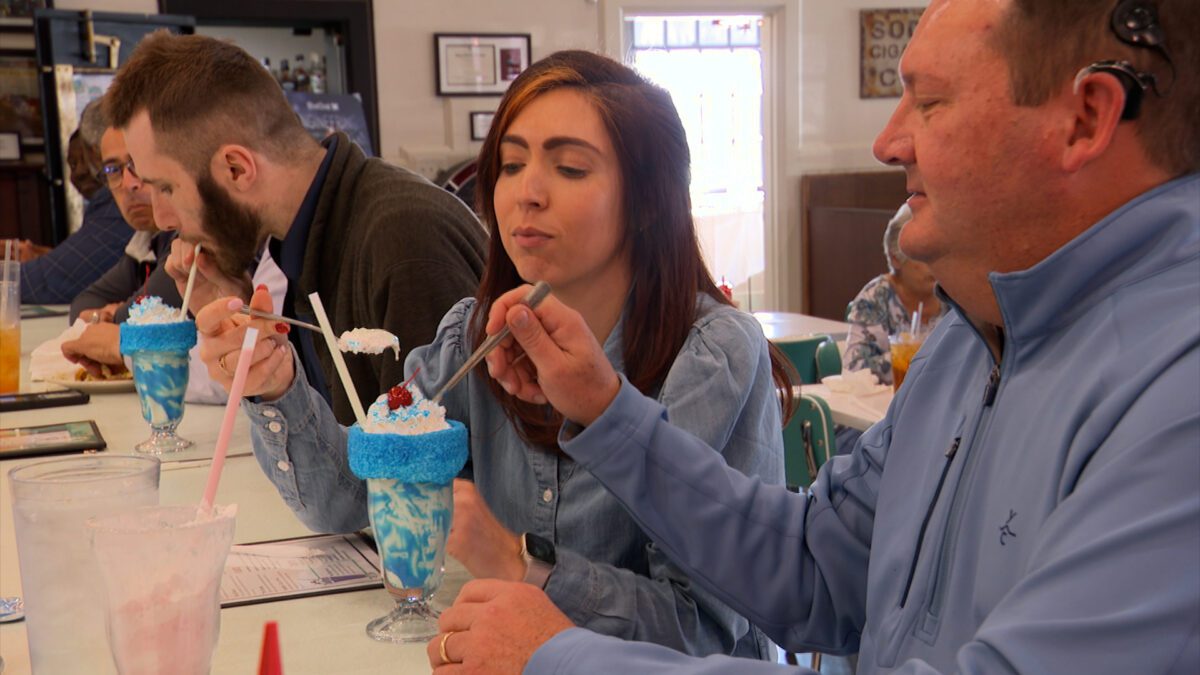
- Here at Livingston Soda Fountain, you know you're going to have a great milkshake, but be sure to have one of the specialty milkshakes on the menu. There are several of them and they are all named for a person or place here in Brownsville. Take this one for example. It is called the Dandy and it is named after Jack Pettigrew's dad. It is chocolate, caramel, and candy.

- We sat down and talked about things in Haywood County that might be fun to attach a milkshake to. And so that's where we got the Muddy Hatchie River, which is chocolate, chocolate, chocolate, chocolate. My wife put her thinking cap back on again, ended up coming up with the blue oval made out of birthday cake ice cream for the birth of Blue Oval City.

- [Cindy] A malt, a homemade pie or a big scoop of ice cream. It is all just what the doctor ordered, and no one here is counting carbs or calories. The only real advice is to relax and enjoy.

- The food is great. The servers are great. It's just a great vibe.

- It's been amazing, and I spend a lot of my time on the floor talking to people, and that's a lot of fun. We had no idea it would be this busy this fast. The whole West Tennessee has been wonderful to us. Brownsville particularly, we've got people that come two and three times a week, which is to me amazing.

- [Mrs. Pettigrew] And on any given Day, Brownsville's a small town. Everybody knows everybody, but I walk out there and I do not know one person in our restaurant. And you will go visit those tables and they'll say, we drove from Dyersburg. We drove from Memphis. We drove from Jackson. So I mean, it's really neat. So I feel like we've kind of become a destination stop for people.

- Yum. Well, thanks, Miranda. Now, since we originally aired that story, the soda shop is under new management, but Vanessa and Sid Vandiver tell us they've done their best to preserve the restaurant as Dr. Jack had it, and it's still just what the doctor ordered. Well, in our Retro Crossroads segment this week, we head back to our seventh season. In 1994, Joe Elmore made a trip down to Chattanooga to take part in a Friday night tradition, The Mountain Opry.

- It's real. I mean, everything that happens here, every Friday night, it's just real. It just all falls in place and we get up here and start playing and singing and having a good time, and it's just real part of Americana that we're trying to preserve here at The Mountain Opry.

- In a way, this is how the Grand Ole Opry was started in Nashville about 70 years ago with some Tennessee musicians getting together to play traditional music for the fun of it. You see, back in the late '70s, some players decided to come up here on Signal Mountain near Chattanooga in what used to be an old school house to start a Friday night tradition, and The Mountain Opry was born.

- We want to welcome everybody to The Mountain Opry this Friday evening. We've got a good lineup of talent for you. We got three or four big bands. We're gonna put them on tonight. You're gonna enjoy it, we're glad you're here. Anybody from outside of the state of Tennessee with us tonight, we're glad you're visiting with us.

- [Joe] Nita Miller and Freeman Bevins are Friday night regulars at The Mountain Opry. They're not here to land a record deal or get discovered by an agent. They're here because they just like to play good old-fashioned mountain music. ♪ And I'll use what I've got ♪ ♪ With grapevine on the door ♪ ♪ And a little old white false chimney at the end ♪

- [Joe] Ray Fox is one of the founders of this 15-year-old tradition, and he compares it to Nashville's Grand Ole Opry in its early years.

- They did it because they enjoyed it, and that's how we're gonna preserve this. These people come up here and play, perform because they enjoy the music. They enjoy each other and they enjoy performing. They enjoy the audience, and we're gonna preserve it that way. Where the Grand Ole Opry, of course, has gone very commercial, which is fine, which is great. We're glad they have because they've done a lot for Tennessee and Nashville, but we're gonna stay this authentic kind of down home, home spun, traditional kind of music.

- [Joe] By day, Ray is head of admissions at the University of Tennessee at Chattanooga. In fact, all band members have regular jobs, although they're quite serious about the work they perform on stage for free every Friday night. ♪ You can hear the cattle mowing in the lane ♪ ♪ You can see the field of bluegrass ♪ ♪ Where I was born ♪ ♪ You can almost hear them cry ♪ ♪ The geese are doing fine ♪ ♪ And I wonder how the old folks are at home ♪ ♪ Never find another a love so true ♪ = [Joe] What are the rules for the musicians in terms of what they can play and what kind of instruments? Are there any?

- A couple. One, acoustical instruments. We do allow one electric instrument, that's the bass, because a lot of the bluegrass bands have gone to bass instrument and it's electric. We do allow that. And we ask them to do this kind of music, bluegrass or mountain traditional kind of music and keep it within that kind of vein. And as long as they do that, it's an open stage.

- [Joe] The audience is full of regulars too, and they bridge the generation gap often several times. There's no admission charge, just a donation box to help cover expenses. Oh, and buck dancing is always optional.

- You got the Cumberland chain of mountains and the Appalachian soul converging here in Chattanooga. From the Cumberland Mountains, you've got from Nashville on down, you've got sort of the country music kind of sound. And from Appalachia, you got the bluegrass and the Appalachian music, and it sort of converges here and you get sort of melting mix of those kinds of music. And it's sort of interesting how it's developed here in Chattanooga. ♪ You'll never find a love so true ♪ ♪ For all I've done I love you ♪

- I love music. I listen more classically than I do this kind of music personally. The reason I enjoy this as much is one, I can perform it. I can't perform classical very well. I don't do Mozart too well, and I can perform this kind of music. And most of the people who come up here are amateurs. I just sort of picked it up and I think that's really good because that's the folk part of it. They started passing it down from one generation to the next.

- Wow, that looks like a good time. And according to their website, The Mountain Opry still features bluegrass music every fourth Saturday of the month. I'm gonna have to get down there. Well, it's good to see them still going after all these years. Well, folks, that brings us to the end of another trip across the state. Thanks for joining us. And be sure to visit our website, TennesseeCrossroads.org, to watch more of your favorite stories, hey, and be sure to leave us a video message for our 40th season. We'll see you next week.

- I'm author Jeff Zentner. Happy 40th anniversary, Tennessee Crossroads. Hi, I'm Allison from Nashville, wishing Tennessee Crossroads a happy 40th anniversary and many more.

- [Announcer] Tennessee Crossroads is brought to you in part by.

- Students across Tennessee have benefited from over seven and a half billion dollars we've raised for education, providing more than two million scholarships and grants. The Tennessee Lottery, game-changing, life-changing fun.

- [Narrator #1] Discover Tennessee Trails & Byways, where adventure, cuisine and history come together. With 16 scenic driving trails, you can discover why Tennessee sounds perfect. Trips can be planned at tnvacation.com.
Tennessee Crossroads
September 17, 2026
Season 40 | Episode 07
THIS TIME ON TENNESSEE CROSSROADS, WE VISIT A WELL-KNOWN ARTIST PURSUING A NEW CREATIVE OUTLET. MEET SOME ANIMALS YOU MAY NOT BE USED TO SEEING IN TENNESSEE. FIND WHAT MAY BE THE BEST MILKSHAKE IN BROWNSVILLE. AND WE’LL GO BACK TO 1994 TO CHECK OUT THE MOUNTAIN OPRY.